

Celebrating Forty Years of Global Environmental Law Leadership
Oregon Law’s student organization Land Air Water (LAW) hosts what is known as the oldest and largest Public Interest Environmental Law Conference (PIELC) on the planet every March – and has for more than four decades – drawing changemakers from around the globe to share their vision for a sustainable future and solutions to the world’s most alarming environmental crises.
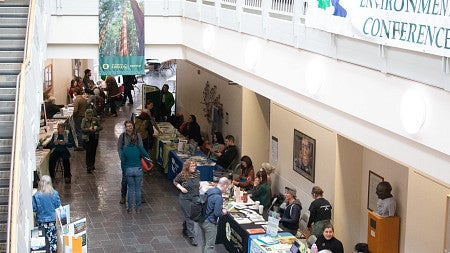
More than a conference, PIELC’s four days are packed with opportunities for education and action. Environmental law students and professionals from many disciplines reignite their passion for the cause through new engagement on the issues, networking, dozens of informative panels and workshops, motivating keynote speeches, and tabling by more than one hundred public interest organizations. The event is a manifestation of the Oregon Law community’s leadership in environmental law and legal education.
The idea for PIELC began with a proposal from now-Professor Emeritus John Bonine in 1980, coming to life three years later. PIELC will celebrate its 44th year in 2026 with the student-selected theme “Fight Back: Voices for Good.”
“We really want to make this a positive year. Give people momentum to go back out in their communities and keep doing the good work that they’ve been working on for so long,” said Abby Dompier, a third-year law student and one of four student organizers planning this year’s PIELC.
Networking fosters change
Philip H. Knight Professor of Law Mary C. Wood, faculty director of Oregon Law’s Environmental and Natural Resources Law Center, recalls her first impressions of PIELC after joining the law faculty.
“It blew me away,” Wood said. “I’d never seen such energy concentrated in one place, combined with the intellectual and scholarly frameworks evolving from that conference. You rarely see such passion combined with serious intellectual, scholarly energy in one place.”
Yet, the formal presentations represent just a fraction of PIELC’s catalytic force, Wood noted. Most of its impact is in informal networking that sparks real change.
“It happens due to the connections that are made,” Wood said. “People leave the conference and they make good on those connections. They use them to advance real environmental progress.”
A boost for students
Everyone benefits, but the value to students is particularly consequential, Wood noted. They:
- Make connections with potential employers, some ending the weekend with multiple job offers.
- Immerse themselves in current environmental law issues—gaining knowledge and skills they can apply in job interviews or legal practice.
- Ignite their passion for public interest environmental law.
- Discover diverse topics that inspire advanced research.
The conference was a reason student organizer Jay Everett, 2L, chose Oregon Law, so he finds it meaningful to contribute to PIELC’s legacy.
He appreciates “seeing the good work that’s being done despite everything. There’s always a struggle, but the degree of that struggle ebbs and flows. It’s nice to see the positive things that are happening,” Everett said.
Alongside Dompier and Everett, this year’s conference co-directors are second-year law students Molly Cochran and Anna Hampton. Associate Professor Greg Dotson serves as faculty advisor.
Forty years of thriving
PIELC has grown dramatically over the years, from about seventy-five participants in 1983 to thousands today. Student volunteers and participants, lawyers, and activists are key reasons for the conference’s success, Bonine said.
“The activist component is extremely important,” Bonine continued. “The hallway full of tables by different groups lends a festival atmosphere to the event that cannot be found elsewhere. The presence of large numbers of activists reminds students, lawyers, and other professionals that there is more to environmental law than just the cold words on a printed page.”
Bonine estimates that at least ten to fifteen percent of the entire population of public interest environmental lawyers in the US attend PIELC annually.
Public interest law conferences have emerged in other parts of the country and around the world. This is a good outcome, Wood notes, because these gatherings invigorate their own communities.
“I’m proud that there are these spinoffs,” Wood said. “But public interest law still finds the vortex of imagination and inspiration at Oregon’s PIELC.”
Legal Disclaimer:
EIN Presswire provides this news content "as is" without warranty of any kind. We do not accept any responsibility or liability for the accuracy, content, images, videos, licenses, completeness, legality, or reliability of the information contained in this article. If you have any complaints or copyright issues related to this article, kindly contact the author above.
